

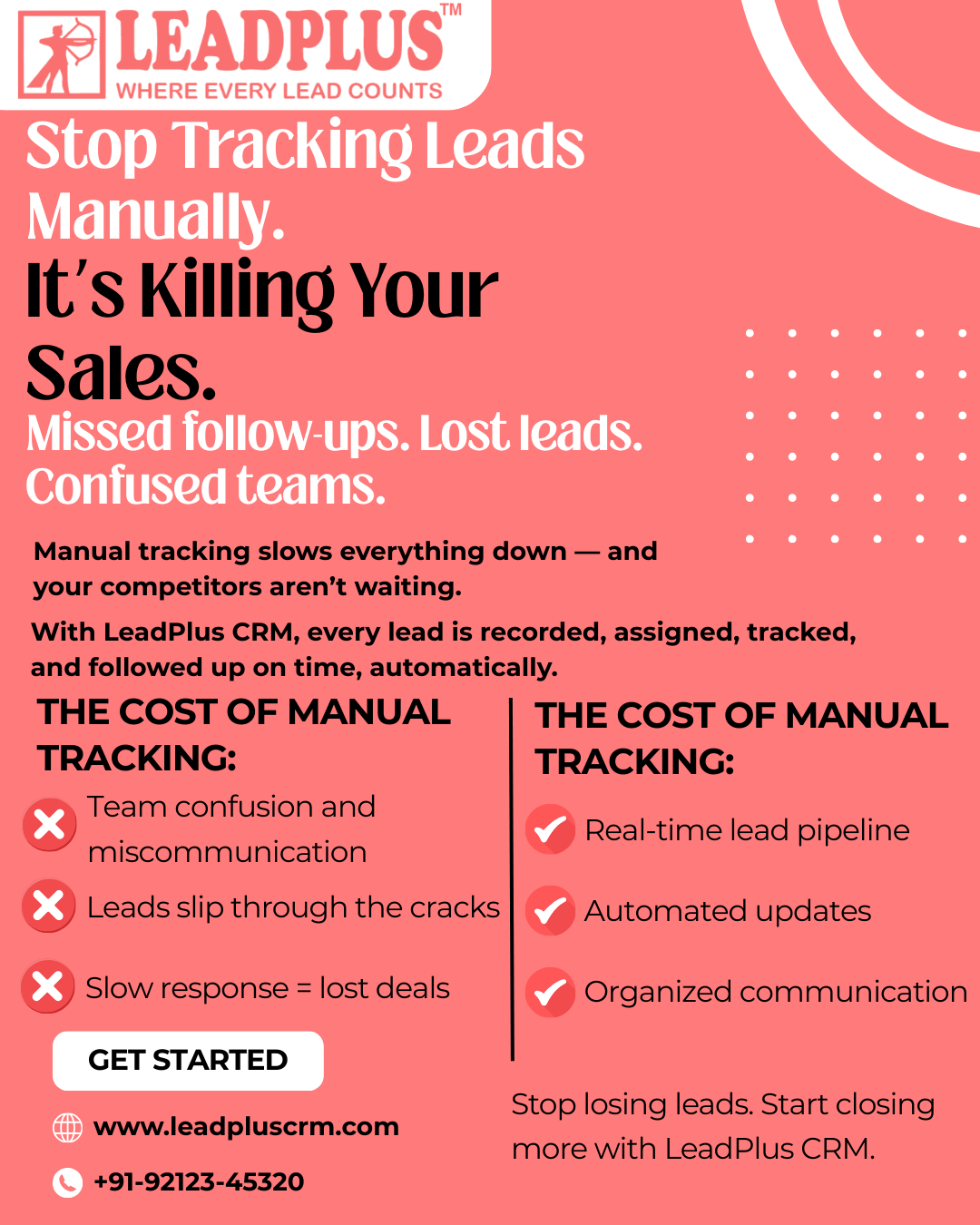
The Hidden Killer-Why Manual Lead Tracking Is Stifling Your Sales and How to Stop the Bleeding
For many small and growing businesses, the humble spreadsheet is a constant companion-the universal tool for organization. We use it for budgets, inventory, employee schedules, and, perhaps most dangerously, lead tracking. It feels safe, familiar, and free-the perfect tool, right? Wrong. While manual tracking using spreadsheets or sticky notes might feel adequate when you have ten leads, it quickly becomes a silent and deadly saboteur as your business begins to scale. Manual lead tracking is not just inefficient; it is actively killing your sales funnel, draining your team's productivity, and introducing catastrophic risks to your revenue stream. If your sales team is struggling to hit targets, and if your revenue forecasting is more like guesswork than the problem isn't your product; it's likely the outdated system you use to manage your most precious asset: your leads. This is why the legacy system of manual tracking is a death knell for modern sales success. Manual tracking systems-be they Excel, Google Sheets, or a physical notebook-suffer from three critical, terminal flaws that make them incapable of supporting a modern sales team. In a manual system, data is only as accurate as the last person who updated and they probably did it at the end of the day, fueled by coffee and rushing to leave. Inaccuracies and Duplication: Leads get entered twice by different reps, contact information is misspelled, and key dates are transposed. This "dirty data" leads to embarrassing mistakes-calling a prospect by the wrong name, or sending follow-up emails to the wrong address-shattering professionalism. Lack of Real-Time Updates: Data in a spreadsheet is static. If a sales rep has a crucial call, but a marketing campaign just sent a follow-up email, neither department knows what the other has done. The customer receives conflicting or redundant messaging-a confusing and frustrating experience. The "Lost Data" Phenomenon: If a high-value lead is logged in Rep A's local spreadsheet, and Rep A quits or loses their laptop valuable relationship data is gone forever. The company, quite literally, loses revenue history and future opportunity-a catastrophic loss. Salespeople are expensive and highly skilled-their most valuable activity is selling. Manual tracking forces them to become data entry clerks, draining their time and crushing their morale. Administrative Overhead: Logging calls, transcribing notes, updating status columns, calculating totals-this administrative busywork can consume 20% to 30% of a salesperson's day. That is hours not spent prospecting, nurturing, or closing-it's the silent killer of productivity. The Search and Retrieve Nightmare: Finding the last interaction with a prospect requires searching through emails, old sheets, and handwritten notes. The few precious minutes before a call are spent scrambling for context, rather than planning strategy-making the call reactive, not proactive. Task Management Failure: Spreadsheets are poor at generating automated reminders. Follow-ups, critical deadlines, and scheduled demos rely entirely on the salesperson's personal calendar or memory highly unreliable system that guarantees missed opportunities. The failures of manual tracking have direct, destructive consequences on the three most important aspects of your sales funnel. When you have hundreds of leads in a sheet, how do you decide who to call first? Manually, the choice is often arbitrary-based on the last person the rep spoke to, or simply who's at the top of the list. No Lead Scoring: Manual systems cannot track crucial engagement metrics-website visits, email opens, and content downloads. You cannot assign a true "hotness" score. Your reps waste time calling "cold" leads who are not ready to buy, while "hot" leads-ready to commit-are left waiting, going cold themselves, or worse, going to a competitor. Poor Nurturing Strategy: Leads require different types of nurturing at different stages. A spreadsheet cannot automatically trigger the right content or assign the lead to the right nurture track-the process is static, generic, and ineffective at driving the prospect toward conversion. The management team requires accurate forecasting to plan inventory, hiring, and investment. Manual systems make this fundamental business function impossible. Inconsistent Stages: Reps label stages inconsistently ("Warm," "Very Interested," "Near Close"). Without standardized, mandatory fields, management cannot accurately aggregate the pipeline data lacks the necessary structure for reliability. The "Hopium" Problem: Sales reps, incentivized by targets, often delay marking a deal as "Lost," keeping it artificially inflated in the spreadsheet. This leads to wildly optimistic forecasts that collapse at the end of the quarter-creating revenue instability and crisis management. No Conversion Metrics: Manual systems cannot easily track historical data to calculate conversion rates (e.g., how many Demos turn into Closed Deals). Without these metrics, forecasting is based on feelings, not mathematical predictability-an unacceptable risk for scaling. Sales leadership needs instant visibility to coach, intervene, and allocate resources effectively. Manual tracking creates a managerial black hole-where data is only visible after it’s been compiled and formatted, usually too late to make a difference. No Real-Time Auditing: Managers cannot see a rep’s daily activity-number of calls, or time spent on task until a report is submitted. There is no instant insight into bottlenecks or poor performance-meaning coaching happens reactively, after a slump has already occurred. Ineffective Coaching: Without detailed logging of call notes and communication history linked to the deal, managers cannot provide data-backed coaching. They rely on the rep’s self-report, which is often biased, incomplete, or simply wrong-undermining talent development. The transition from the chaos of manual tracking to the control of a CRM (Customer Relationship Management) system solves all of these problems simultaneously-it transforms the sales organization from a reactive, messy operation into a clean, proactive revenue engine. Forced Data Integrity: CRMs mandate standardized fields (e.g., using drop-down menus for deal stages, ensuring data is clean). Logging calls and emails is automated-eliminating manual entry errors. Instant Visibility: Managers gain instant, real-time dashboards showing pipeline health, rep activity, and accurate forecast summaries-allowing for proactive intervention and real-time coaching. Predictive Prioritization: The system automatically scores leads based on engagement and moves them through a standardized nurture workflow-ensuring the right rep calls the right person at the optimal moment. Revenue Predictability: By enforcing standardized stages and logging every activity, the CRM provides the clean, historical data necessary to calculate accurate conversion rates-turning forecasting into a reliable, mathematical exercise. If you recognize your business in the chaos of manual lead tracking-the lost notes, the forgotten follow-ups, the sudden forecast collapse-then your current system is actively standing in the way of your growth. The era of relying on human memory, spreadsheets, and sticky notes to manage your most valuable relationships is over. A sales team that spends all day logging data is a sales team that is not selling. The only way to achieve sustainable, scalable revenue is to embrace smart automation. Invest in a CRM, free your team from the administrative burden, and transform your sales process from a frustrating gamble into a predictable, powerful growth machine-it's the only way to ensure your leads are nurtured, not killed.
Part I: The Core Failures of Manual Lead Tracking
1. The Data Integrity Disaster-It's Simply Not True
2. The Productivity Drain-Killing Your Team's Time
Part II: How Manual Tracking Sabotages the Sales Funnel
1. Lead Prioritization Is Impossible
2. Sales Forecasting Becomes Guesswork
3. The Managerial Black Hole
Part III: The Solution-Transitioning to Smart Automation
Conclusion: Stop Logging, Start Selling