

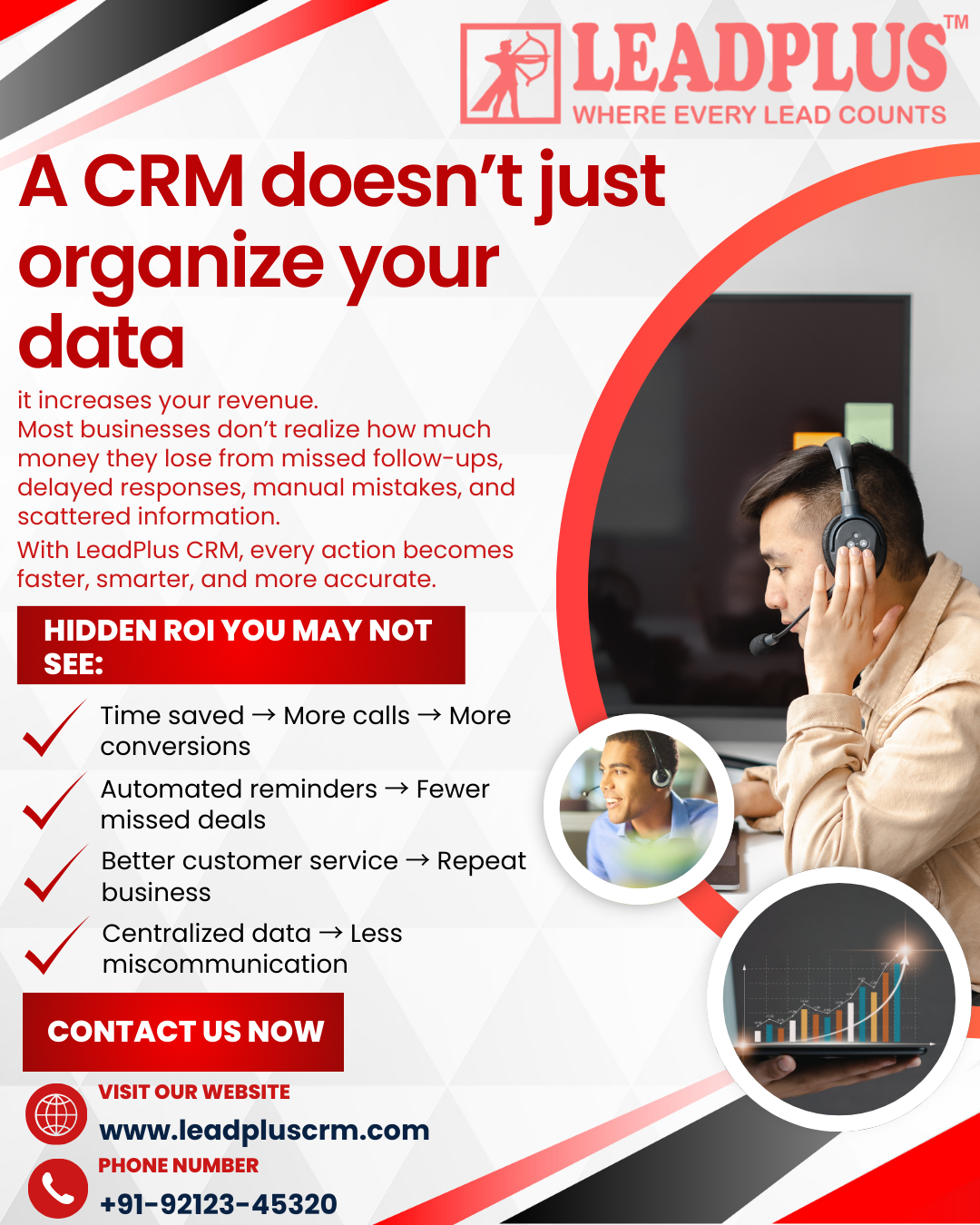
Beyond Sales-Unlocking the Hidden ROI of CRM Software Across Your Entire Business-The True Financial Justification
When leadership evaluates a major software investment like a CRM (Customer Relationship Management) system, the initial focus is always on the direct ROI-the immediate, measurable gains in the sales department. Will it boost conversion rates? Will the sales team close deals faster? These are necessary questions, but they tell only half the story-the easily quantifiable half. The true, transformative financial justification for a CRM lies in its Hidden ROI-the powerful, compounding returns generated by increasing efficiency, mitigating risk, and enhancing strategic decision-making across the entire organization marketing and finance to customer service and IT. For businesses looking to justify the investment and maximize its value, you must look beyond the sales pipeline. Here is how a CRM delivers crucial, often overlooked, financial dividends that make it arguably the best investment a modern business can make. Before exploring the hidden benefits, it is worth acknowledging the primary, measurable returns that form the initial business case for a CRM. Increased Sales Velocity: Automation eliminates bottlenecks-no more searching for notes or waiting for quotes. This decreases the time it takes for a lead to move through the funnel-meaning more closed deals per quarter per rep. Improved Conversion Rates: Predictive lead scoring ensures sales reps focus their efforts on the "warmest" leads. Wasted time is eliminated-directly improving the percentage of qualified leads that become paying customers. Higher Average Deal Size: By providing reps with a clear 360-degree view, CRMs reveal upsell and cross-sell opportunities instantly-allowing reps to easily bundle relevant services, increasing the total value of each transaction. These benefits are powerful-but they are only the starting point for calculating the system’s true financial impact. The most significant hidden returns come from stabilizing the top-line revenue and ensuring long-term customer value. Acquisition costs are massive. The long-term profitability of a business is tied directly to how long it keeps its customers and how much they spend over that period. Proactive Retention: CRMs use behavioral data to flag customers at risk of churn. By intervening proactively with personalized support, the company significantly reduces customer attrition-saving the high cost of replacement and protecting future subscription revenue. Targeted Loyalty Programs: The CRM segments customers based on purchase history and value. This allows marketing to execute loyalty programs and exclusive offers that drive repeat business and increase the frequency and size of subsequent purchases-exponentially boosting CLV. Unreliable revenue forecasts lead to crippling mistakes-overhiring, under-stocking inventory, or losing out on investment opportunities. Reducing Inventory Risk: For product-based businesses, accurate pipeline visibility provided by the CRM allows the operations team to plan manufacturing and inventory with confidence, reducing carrying costs and avoiding costly rush orders. Smarter Hiring Decisions: Leadership can hire new sales reps based on real, predictable pipeline projections, rather than optimistic "gut feelings." This reduces the financial risk of hiring too early or too late-aligning operational costs precisely with anticipated revenue. The second major area of hidden return is cost savings-the money saved across departments that never shows up on the sales team's performance report. When marketing lacks insight into what converts, budgets are often wasted on ineffective channels or generic campaigns. Data-Driven Budget Allocation: The CRM shows which lead sources deliver not just volume, but high-value conversions. Marketing can instantly re-allocate budget away from weak channels and towards the most profitable ones direct reduction in cost per acquisition (CPA). Campaign Personalization: Automated segmentation ensures marketing messages are hyper-targeted. Fewer irrelevant messages means higher engagement and lower "spam" complaints-saving money and protecting the brand reputation. A smooth, fast support experience is crucial, and CRMs make support agents exponentially more efficient. First Call Resolution (FCR): With instant access to the customer’s purchase history, trouble ticket logs, and communication history, support agents solve problems faster. Reduced call handling time (AHT) and higher FCR rates directly translate into lower operational costs for the service center. Reduced Ticket Volume: By proactively identifying and addressing common product issues or confusion (flagged by the CRM), the service team can reduce the total number of incoming support tickets-a substantial, long-term cost reduction. High employee turnover is incredibly expensive due to recruitment, training, and lost productivity. A functional CRM acts as a massive retention tool. Reduced Administrative Burden: Sales reps who spend less time on tedious data entry and more time on high-value tasks are happier, more productive, and less likely to burn out. Faster Onboarding: CRMs enforce a standardized process-a clear blueprint for success. New hires get up to speed faster, meaning they contribute revenue sooner, and the cost of training time is dramatically reduced. Finally, the CRM delivers returns that are almost impossible to quantify immediately but are the backbone of future strategic success. A seamless, personalized customer experience builds massive brand trust-an asset that allows you to charge premium prices and withstand market challenges. Consistent Experience: The CRM ensures the customer receives a unified message from every department. This consistency builds reputation and credibility-allowing the company to compete on value and experience, rather than just on price. In today's fast-moving market, the ability to pivot based on real-time data is critical. Rapid Feedback Loops: The CRM provides instant feedback on product acceptance, campaign response, and competitive losses. This intelligence allows product development and strategy teams to make faster, more informed pivots-giving the business crucial agility that competitors lacking centralized data simply cannot match. The ROI of CRM software is never a simple calculation of "Sales Rep X closed Y more deals." It is a complex, far-reaching equation that touches every budget line and strategic pillar of the organization. The true financial justification for a CRM is found in the summation of its hidden benefits: the increased CLV, the reduced marketing waste, the lower service costs, the decreased employee turnover, and the profound mitigation of financial risk through accurate forecasting. By understanding and tracking this total, compound ROI, businesses realize that the CRM is not merely an expense-it is the single most powerful, strategic investment they can make to secure long-term revenue stability and unlock untapped organizational value.
Part I: The Direct, Measurable ROI (The Visible Tip of the Iceberg)
Part II: Hidden ROI in Revenue and Growth
1. Exponential Increase in Customer Lifetime Value (CLV)
2. Accuracy in Forecasting-Mitigating Financial Risk
Part III: Hidden ROI in Cost Reduction and Operational Efficiency
3. Marketing Waste Reduction
4. Customer Service Cost Savings
5. Employee Productivity and Retention
Part IV: The Strategic ROI-Brand Equity and Agility
6. Brand Equity and Trust
7. Organizational Agility
Conclusion: The Total Financial Picture